
Plumbing & HVAC Content Marketing
Built for Authority, Rankings, and Booked Calls
Most contractor content is written to fill a blog page. It ranks for searches outside your service area. It pulls in homeowners who aren't buying. It has no path to a booked call.
- Built around how customers search for plumbing and HVAC in your market
- Connected strategy across Google Maps, organic, and local search
- Compressed to essentials: structure, intent, conversion — and only what actually works
No generic home services approach. Built for plumbing and HVAC operators only.
One plumbing client and one HVAC client per market.
The Problem
Why Most Plumbing & HVAC Content Marketing Doesn't Produce Calls
Plumbing and HVAC are local, intent-driven trades. A homeowner searching "furnace repair near me" at 10pm is not browsing. They are calling whoever surfaces first with clear, credible, relevant content. Most contractor content fails that test.
Informational content that pulls traffic from outside your service area. Visits that will never become calls.
"Ultimate guide" articles with no conversion structure or CTA. You educate the reader, and your competitor gets the call.
No internal linking architecture connecting content to service pages. Authority that can't flow where it needs to.
City pages with identical content and swapped city names. Geographic signals that Google dismisses as duplicate content.
No AI-structured formatting — no FAQ blocks, no semantic hierarchy. Invisible to AI overviews and voice search results.
Content disconnected from paid advertising and GBP strategy. Channels operating independently instead of as a system.
Traffic that doesn't convert is not growth. It's cost. When a homeowner's water heater fails on a Sunday, they don't read blog posts. They scan the Map Pack and the top organic results, and they call. Every content asset we build is designed to support one of those positions.
What Changes When Content Marketing Works
These outcomes only appear when content is built around how plumbing and HVAC demand actually works — not around page volume.
01 — Geographic Market Control
Service-area content built around your actual dispatch radius, not the nearest major metro. City-level pages that reinforce GBP service categories, support proximity rankings, and capture the near-me searches your competitors are leaving on the table.
02 — Topical Authority Recognition
Interlinked content clusters that tell Google you are the authoritative source for drain cleaning, water heater replacement, AC repair, or whatever your highest-margin services are. Clusters built to compound — each new page strengthens the ones around it.
03 — AI Visibility and Citations
Semantically structured content formatted so that AI systems — Google AI Overviews, voice search, assistant queries — pull from your pages rather than competitors'. When a homeowner asks "how long does a water heater last," your company is the source that gets cited.
04 — Lead Generation at Scale
Content designed with conversion architecture from the first paragraph. Clear calls to action. Phone-first structure. Internal links to high-conversion service pages. Every asset earns its place by moving the reader toward a booked call.
Ready to Own Your Market?
Schedule a Consultation Now
A short, no pressure conversation to understand your shop, your service area, and whether DemandStream is the right fulfillment partner for your next phase of growth.
One Plumbing company and one HVAC company per market. Real conversations, not sales calls.
Schedule a Consultation NowTakes about 60 seconds to qualify. We'll follow up within one business day.
The Market Domination Framework for Content Marketing
Every content engagement runs through this framework. Foundation first. Then infrastructure. Then expansion. Then ongoing optimization. In that order, every time.
Audit & Strategy
Foundation
Before a single piece of content is written, we establish what you already have, what your market needs, and what your competitors are missing.
What This Phase Includes
- Content audit of existing pages and performance
- Keyword and gap analysis by service and geography
- Competitive content research across your market
- Hub-and-spoke topic mapping aligned to service architecture
- Conversion path planning from content to booked call
Foundation typically spans 2 to 4 weeks. Core content build runs 2 to 3 months. Expansion and optimization assets compound over 6 to 12 months.
The Levers We Pull
The Levers We Pull in Competitive Plumbing & HVAC Markets
Each content component is scoped based on your market's competition level, your current content gaps, and your highest-margin revenue targets. No standard packages. No fixed deliverable lists that ignore what your market actually requires.
Geographic Content Pages
Service-area pages built around your actual dispatch radius. City-level relevance that reinforces GBP categories, supports proximity rankings, and captures near-me searches that convert.
Topical Cluster Build-Outs
Hub-and-spoke architecture connecting service hubs to supporting articles to city pages. Builds the topical depth Google requires before awarding rankings in competitive geographic markets.
Maps Influence Content
GBP-aligned content assets — optimized service descriptions, local Q&A, and geotagged supporting pages — that reinforce Map Pack signals and lift proximity rankings in markets where organic alone isn't enough.
Power Posts
"How long does a water heater last," "Signs your AC needs replacement," "What causes low water pressure." Long-form, intent-matched content written to rank and to pre-sell.
Case Studies
Real outcome documentation. What the problem was, what we built, what changed. Designed to convert decision-stage visitors who need proof before they call.
Listicles & Comparison Content
"Best water heater brands," "HVAC company reviews near me." Research-stage content that intercepts high-intent comparison searches and positions your company as the authoritative local answer.
E-books & Downloadable Guides
"What to Do When Your Furnace Fails," "Homeowner's Guide to Water Heater Replacement." Built around your highest-priority services to capture demand before it goes to a competitor.
Press Releases
Locally distributed releases tied to new service offerings, certifications, expansions, and community presence. Builds citation signals and reinforces local authority.
Lead Magnets
Maintenance checklists, seasonal tune-up reminders, and cost estimators that capture homeowner contact information at the research stage — before they're ready to call and before they find a competitor.
Trade-Specific Execution
Built for Both. Engineered for Each.
Plumbing and HVAC are different trades with different demand patterns, different seasonality, and different keyword structures. Every content strategy we build treats them separately, even when we serve both for the same operator.
Plumbing Content Marketing
Plumbing demand is largely emergency-driven. A burst pipe, a failed water heater, a backed-up main line — these are not planned purchases. The homeowner searches, scans the top results, and calls. Plumbing content marketing has to win that moment.
- Emergency and high-intent keyword prioritization: 'burst pipe repair [city],' 'water heater replacement [city]'
- Geographic content pages aligned to your actual dispatch coverage — not just major city names
- Review velocity support: content that reinforces trust signals for emergency callers comparing options
- GBP category alignment for drain cleaning, water heater, slab leak, and repiping revenue
- Multi-truck radius scaling: as your coverage expands, the content structure scales with it
HVAC Content Marketing
HVAC demand is seasonal and dual-natured — emergency repair in peak season and planned replacement year-round. HVAC content marketing has to capture both: no-cool calls in summer and equipment changeout intent before a system fails.
- Heating vs. cooling keyword splits by season and market climate zone
- Install vs. repair content structure: each service type gets its own page, its own intent targeting
- Maintenance agreement visibility: content positioning for tune-up and annual service plan searches
- Seasonal demand alignment: no-cool spikes, freeze prep, and shoulder season strategies
- Equipment transition and changeout keyword capture for high-margin replacement revenue
Selective Fit
Is Plumbing & HVAC Content Marketing Right for Your Company?
We work best with established plumbing and HVAC companies that want to own their service area — not just generate a few more organic visits this month.
This Could Work Well
Probably Not a Fit
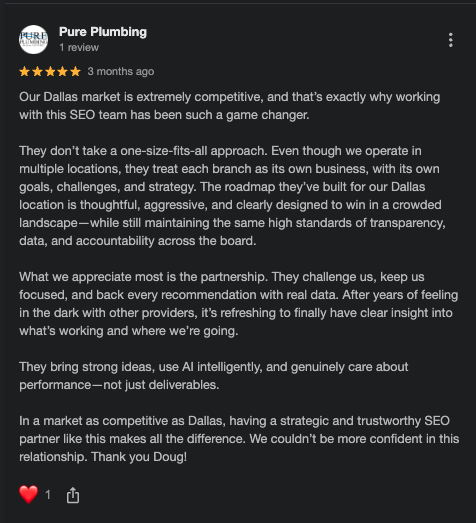
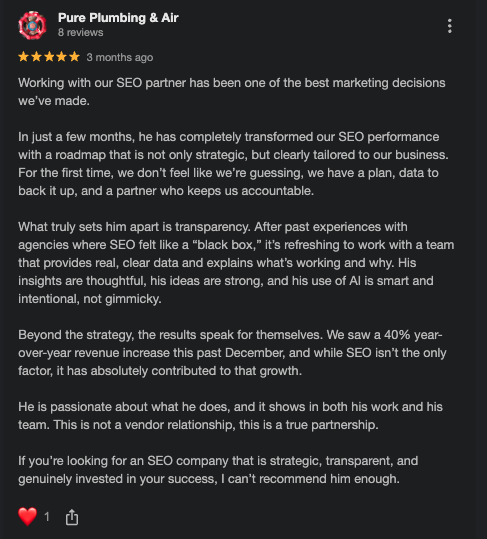
What Plumbing & HVAC Operators Say
Real Shops. Real Words. Real Money Found.
Common Questions
Frequently Asked Questions About Plumbing & HVAC Content Marketing
Results & Timing
Content Marketing vs. Paid Ads
Process & Delivery
The Bigger Picture
Plumbing & HVAC Content Marketing Is Part of a Bigger Growth System
Content marketing drives topical authority and geographic relevance. But it produces the strongest results when it works with the rest of the marketing system — not in isolation from it.
Your content strengthens your Google Maps performance. Your GBP reviews improve the trust signals that make content convert. Your paid ads capture the demand your content surfaces. Your email marketing reactivates past customers before they search for a new plumber or HVAC company. Your reporting dashboard connects all of it to cost per booked call.
See If Your Market Is Available
Tell us where you operate and what you're working toward. We'll take it from there.
One plumbing company per market. Your competitors don't get in.
Ready to Own Your Market?
Schedule Your Growth Audit
Walk through your service area, capacity, and growth targets with our team. We confirm fit before any pitch.
One plumbing or HVAC company per market. Your competitors don't get in.
Claim Your Territory Today60 seconds to qualify. Follow up within one business day.
"What truly sets them apart is transparency. After past experiences with agencies where SEO felt like a 'black box,' it's refreshing to work with a team that provides real, clear data and explains what's working and why."
Pure Plumbing & Air — Google Review