We value your privacy
We use cookies to enhance your browsing experience, analyze site traffic, and personalize content. By clicking "Accept All", you consent to our use of cookies. Read our Privacy Policy to learn more.

Plumbing & HVAC Digital Marketing & AI Automation Company
Built to Drive More Booked Service Calls
We help plumbing and HVAC companies generate more booked service calls. SEO, Google Maps, paid advertising, Local Services Ads, email marketing, AI Automation and website design, built as one connected system.
- Booked calls tracked into ServiceTitan, not vanity impressions
- One market, one plumbing or HVAC operator. No competing accounts.
- Built and run by Plumbing and HVAC operators, not generalists
No generic home service marketing. Built for plumbing and HVAC companies only.
One plumbing client and one HVAC client per market.
15+ Years of Execution
Local Service Marketing. Now Focused on the Trades.
All of that experience now lives inside DemandStream Digital. We've been the fulfillment engine behind successful agencies and direct clients alike. Now applied exclusively to plumbing and HVAC.
Marketing Built for Plumbing & HVAC Operators
Most marketing agencies treat plumbing and HVAC companies like any other business. DemandStream doesn't. Every strategy is built around how customers search for plumbers and HVAC services in your local market, and what it takes to turn that search into a booked job.
You See Every Dollar
Complete visibility at every step
You know where your budget is going and what it's producing. Leads, calls, cost per booked call. No black boxes.
Your Booking Rate Is the Metric That Matters
Results you can see
We don't report impressions. We track booked calls, cost per booked call, and booking rate. Those are the numbers that show up on your dispatch board.
Built for Your Market, Not a Template
Built for your market
We don't apply the same keyword list and call it done. Your service area, your competition, and your peak seasons drive every decision.
Generic marketing ignores your service area, your competition, and your season. DemandStream builds around all three: search, paid ads, email, and reputation working together to drive calls.
One System. Every Channel.
More Booked Service Calls
Here's how the system actually works:
Our plumbing and HVAC marketing services combine local SEO, Google Maps, paid advertising, reputation growth, and website design built to convert. All structured to increase booked service calls and revenue stability.
Each service reinforces the others. That connection is what creates predictable call flow you can build a schedule around.
See the Full BreakdownWebsite Design
Custom high-performance websites built for the trades. Mobile-first, fast-loading, and architected to convert visitors into booked calls, with location and service area pages baked in from day one.
Learn moreLocal SEO
We target high-value, high-volume searches like "hydro jetting [city]" and "water heater installation [city]" alongside high-intent near-me terms, prioritizing what drives the most booked jobs.
Learn moreGoogle Maps / GBP
Over 70% of local searches stop at the Google Maps results. We improve your Google Business Profile, reviews, and local signals to get you into that top three.
Learn morePaid Advertising
More than Google Ads. We run a connected paid strategy: Google Ads, retargeting with AdRoll, and social ads on Facebook and Instagram. Built to capture demand, follow up on missed calls, and keep your name in front of people who searched but didn't book.
Learn moreContent Development
Service pages and city pages built to rank for high-intent searches in your market. Content that turns traffic into calls.
Learn moreEmail Marketing
Keep past customers coming back with seasonal reminders, maintenance offers, and follow-up sequences that book the next job before they search for someone else.
Learn moreAIO & GEO
Optimize your content for AI-powered search engines and generative answer platforms. As Google AI Overviews, ChatGPT, and Perplexity reshape how homeowners find contractors, we position your brand to appear in AI-generated answers, not just traditional search results.
Learn moreAI Automation
Put your follow-up on autopilot. AI-powered workflows that respond to missed calls, re-engage cold leads, and nurture estimates so no opportunity falls through the cracks.
Learn morePlumbing and HVAC companies operate under real-world pressures: EPA Section 608 requirements, refrigerant transition timelines, peak-season demand spikes, and technician capacity constraints. Our strategies are built to reflect those realities, not ignore them.
Plumbing & HVAC Digital Marketing Results
Real results for real clients. See how we've helped businesses dominate their local markets.
Plumbing & HVAC SEO Case Study – Las Vegas | 57-Point Keyword Growth
Plumbing SEO Case Study – Dallas | +306% Organic Growth
Your Market
This market is still open. Be the only client we take here.
Ready to Own Your Market?
Schedule a Consultation Now
A short, no pressure conversation to understand your shop, your service area, and whether DemandStream is the right fulfillment partner for your next phase of growth.
One Plumbing company and one HVAC company per market. Real conversations, not sales calls.
Schedule a Consultation NowTakes about 60 seconds to qualify. We'll follow up within one business day.
Our Process
From Audit to Growth
A structured approach. No guesswork. No random tactics.
We do not treat digital marketing like a monthly experiment. We build it in phases. Every phase has a purpose. Every phase builds on the last.
Audit & Roadmap
Before anything is rebuilt or launched, we map the next 6 to 12 months of growth.
What We Focus On
- Evaluating your website and visibility
- Reviewing competitors in your service area
- Identifying your most profitable services
- Analyzing local opportunities
- Mapping SEO and paid priorities
What You Can Expect
By the end of this phase, you have clarity.
You know what needs to be fixed, what should be prioritized, and where growth will come from.
- A written strategic roadmap
- Defined revenue priorities
- Clear execution sequence
- Zero guesswork
The 30-Day Strategic Growth Roadmap is a standalone engagement. If you move forward with implementation, a minimum six-month commitment begins after roadmap delivery.
Plumbing & HVAC
Built for Both. Tailored to Each.
Plumbing
Marketing built for plumbing companies, from drain cleaning to full repiping. We help you rank, get found, and book more jobs. Also available for multi-location operators.
7 services. Click to explore
HVAC
Marketing built around HVAC seasonality, service calls, and install revenue. Built to keep your schedule full year-round.
7 services. Click to explore
The Partnership
What Working With Us Looks Like
Every campaign is built around how customers search for plumbers and HVAC companies in your specific market, and what it takes to get them to call.
Monthly Strategy Reviews
Every month we walk through what's working, what's changing, and what's next. No guessing, no waiting for quarterly reports.
Dedicated Account Lead
One point of contact who knows your business inside and out. Not a rotating door of reps who need to be caught up every call.
Clarity Dashboards
See your rankings, leads, ad spend, and booked calls in one place. No digging through spreadsheets or waiting for a report.
Problems Get Caught Early
We monitor campaigns constantly and catch issues before they show up in your numbers. No surprise bad months.
AI-Resourced Strategy
We use AI tools to increase output, sharpen targeting, and stretch your budget further. All guided by experienced marketers who know the trades.
Not for Everyone
If you're looking for the cheapest option or overnight results, we're not the right fit. This works best for companies serious about long-term growth.
An Honest Word From Our Founder
Marketing Isn't One Thing Anymore.
It's Everything, Connected.

Doug Bryson
Founder, Demand Stream Digital
It's everything, connected.
Since 2011, I've managed hundreds of campaigns for local businesses. Over time, I kept coming back to the same types of clients: plumbing and HVAC companies doing great work but struggling to get found online.
That pattern led me to go all in. I stopped serving every industry and built everything around the trades — the systems, the strategy, the team.
A single channel doesn't win markets.
Search, ads, reputation, email, and web design have to work together. When everything connects, you own your market.
If that's the kind of marketing you've been looking for, let's talk.
Doug
Straight Talk
Are We the Right Fit for Your Shop?
We work with established plumbing and HVAC companies that want to own their service area, not just generate random traffic.
This Could Work Well
Probably Not a Fit
How It Works
Digital Marketing for the Trades
Your Role
Share your goals, service area, and the competitors you see in the field. We handle the research.
- Tell us which markets and services matter most
- Share what you know about your competition
- Identify your growth priorities
Our Role
We analyze your local market, competitor positioning, and search landscape to identify the biggest opportunities.
- Competitive keyword and ranking analysis
- Local search opportunity mapping
- Market gap identification
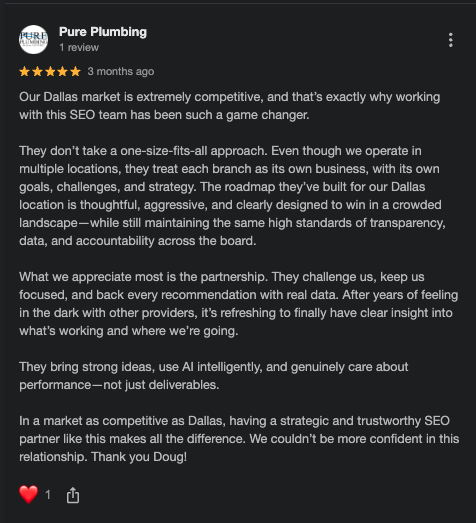
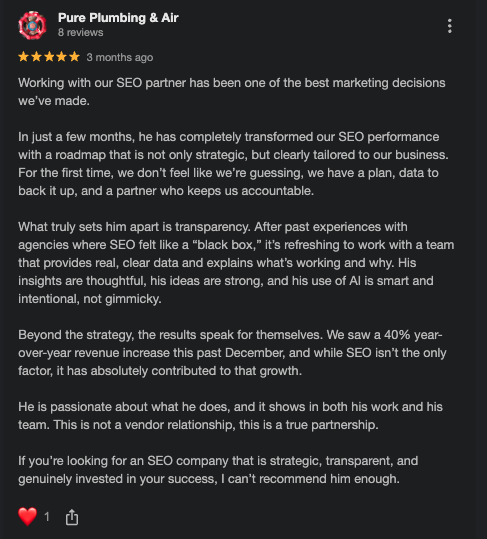
Real Reviews From Real Operators
Real Shops. Real Words. Real Money Found.
Questions Contractors Ask
Common questions from plumbing & HVAC business owners.
See If Your Market Is Available
Tell us where you operate and what you're working toward. We'll take it from there.
One plumbing company per market. Your competitors don't get in.
Ready to Own Your Market?
Schedule Your Growth Audit
Walk through your service area, capacity, and growth targets with our team. We confirm fit before any pitch.
One plumbing or HVAC company per market. Your competitors don't get in.
Claim Your Territory Today60 seconds to qualify. Follow up within one business day.
"What truly sets them apart is transparency. After past experiences with agencies where SEO felt like a 'black box,' it's refreshing to work with a team that provides real, clear data and explains what's working and why."
Pure Plumbing & Air — Google Review